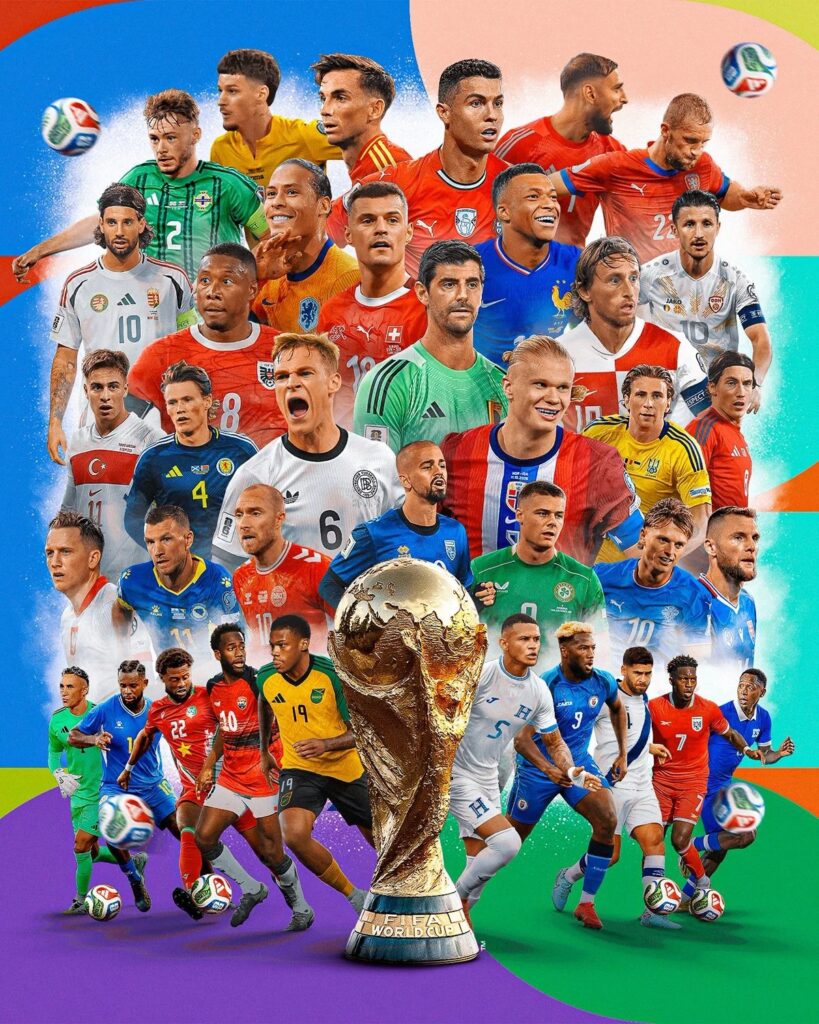
The biggest football tournament in history has arrived. The 2026 FIFA World Cup kicks off on 11 June and runs until 19 July, spanning 39 days, three host nations, and a record-breaking 48 teams. Whether you are planning your viewing schedule, picking a team to follow, or simply soaking in the build-up, this is SCOUT90’s complete guide to everything you need to know about the tournament — the format, the dates, the host cities, the groups, and the favorites chasing glory in North America.
The Basics: When, Where & How Big
The 2026 World Cup is the largest in the tournament’s history and the first ever to be co-hosted by three nations: the United States, Canada, and Mexico. It is also the first to feature 48 teams — a major expansion from the 32-team format that had been in place since France 1998. The competition runs from 11 June to 19 July across 16 host cities, with a record 104 matches to be played, up from 64 at Qatar 2022.
The three hosts qualified automatically, while the remaining 45 nations earned their places through a gruelling two-year qualification process across FIFA’s six continental confederations. The United States will host the lion’s share of matches across 11 stadiums, with Mexico and Canada staging the remainder across their venues.
The New Format Explained
With 48 teams, the structure has changed significantly. The nations are divided into 12 groups of four, with every team guaranteed three group-stage matches. The top two from each group advance automatically, and they are joined by the eight best third-placed finishers — meaning 32 of the 48 teams progress to the knockout rounds. Only the teams finishing bottom of their groups, plus the weakest third-placed sides, are eliminated at the first hurdle.
That sets up a brand-new Round of 32, an extra knockout round that did not exist in previous editions. From there, the tournament follows the familiar single-elimination path: Round of 16, quarter-finals, semi-finals, and the final, with a third-place playoff contested by the losing semi-finalists the day before the showpiece. In total, 72 group-stage matches and 32 knockout games make up the 104-match marathon.
The Opening Match & The Final
The tournament opens on 11 June at the iconic Estadio Azteca in Mexico City, where hosts Mexico face South Africa in a Group A clash — a rematch of the 2010 World Cup opener. The occasion carries genuine history: the Azteca becomes the first stadium ever to host the opening match of three different men’s World Cups, having previously staged the curtain-raisers in 1970 and 1986.
The final will be held on 19 July at MetLife Stadium in New Jersey — referred to as the New York New Jersey Stadium during the tournament, as FIFA has renamed all venues to match their host cities and restrict ambush marketing. It is there, just outside New York, that the 2026 world champions will be crowned.
The Host Cities
Matches will be spread across 16 cities in three countries. In the United States, host cities include Los Angeles, New York/New Jersey, Seattle, Dallas, Houston, Kansas City, Boston, Philadelphia, Miami, and the San Francisco Bay Area. Mexico contributes Mexico City, Guadalajara, and Monterrey, while Canada hosts matches in Toronto and Vancouver. It is a vast geographical footprint that will test teams with significant travel, varied climates, and — as several squads have already discovered — punishing summer heat in some venues.
The Groups: Where the Big Names Landed
The 48 teams were drawn into 12 groups of four. Here is where some of the headline nations and hosts ended up:
- Group A: Mexico, South Africa, South Korea, Czechia — the hosts open the tournament here.
- Group B: Canada and Bosnia & Herzegovina headline the co-hosts’ group.
- Group D: United States, Paraguay, Australia, Türkiye — a navigable draw for the co-hosts.
- Group H: Spain, Uruguay, Cape Verde, Saudi Arabia — the favorites with a favorable path.
- Group I: France, Senegal, Norway, plus a playoff qualifier — arguably the toughest group of all.
- Group J: Argentina, Austria, Algeria, Jordan — a kind draw for the defending champions.
- Group K: Portugal, Colombia, Uzbekistan, plus a playoff qualifier.
- Group L: England, Croatia, Panama, Ghana.
The hosts each begin early: Mexico open proceedings on 11 June, while both the United States (against Paraguay at SoFi Stadium) and Canada (against Bosnia & Herzegovina at Toronto’s BMO Field) get underway on 12 June.
The Favorites
This is shaping up to be one of the most open World Cups in memory, with a cluster of European heavyweights leading the betting alongside the traditional South American powers.
Spain and France sit as the joint front-runners, separated by the thinnest of margins at the top of the market, with both priced around the +450 to +500 range. England follow as the third European contender (roughly +650 to +700), carrying the familiar weight of a nation still chasing its first World Cup since 1966. Brazil, the most successful nation in tournament history, are the leading hope from outside Europe at around +800 to +900.
Portugal have surged in the betting to around +850 to +900, emerging as a genuine dark-horse threat, while defending champions Argentina — still featuring Lionel Messi — sit at roughly +900, with bookmakers wary of the historic difficulty of retaining the trophy. Behind them, Germany (around 14-1) and the Netherlands (around 20-1) lurk as proven tournament sides, with Norway (around 35-1) an exciting outside bet. Among the hosts, the United States shortened to around 50-1 after a favorable group draw and home advantage.
Players to Watch
The tournament is packed with superstars at the peak of their powers. Kylian Mbappé leads the France attack and is among the favorites for the Golden Boot. Lamine Yamal, the teenage sensation, spearheads a thrilling Spain side. Harry Kane arrives for England in peak condition after a record-breaking season at Bayern Munich. Erling Haaland will look to fire Norway to an unlikely deep run, while Lionel Messi, in what is almost certainly his final World Cup, aims to bow out by defending Argentina’s crown. With Yamal and Mbappé representing the new generation and Messi the old, the tournament offers a perfect changing of the guard.
What the Expanded Format Means
The jump from 32 to 48 teams fundamentally changes the tournament’s texture. More teams means more matches, a longer competition, and more opportunities for fatigue, upsets, and surprise packages to shake up the bracket. The favorites will face a more demanding path than ever, and squad depth could prove decisive in the latter stages. For smaller footballing nations, simply qualifying is a historic achievement; for the giants, the expanded format is a test of endurance as much as quality. The new Round of 32 also means more knockout drama than any previous edition.
A Note for Indian Fans
For the millions of football supporters across India, the World Cup is the pinnacle of the sport. While India are not among the 48 qualifiers, the passion for the global game runs deep, with allegiances split fiercely between the traditional powerhouses. Argentina and Brazil command enormous followings, while the European elite — Spain, France, England, and Portugal — have their own devoted Indian fan bases, fuelled by the popularity of club football. The North American hosting brings demanding late-night and early-morning kick-off times for Indian viewers, but that has never dimmed the enthusiasm for the communal watch-parties that make tournament football so special.
Key Dates at a Glance
- 11 June: Opening match — Mexico vs South Africa, Estadio Azteca, Mexico City
- 12 June: USA and Canada begin their campaigns
- 11 June – 27 June: Group stage (72 matches)
- Late June onward: Round of 32 begins — the new expanded knockout phase
- 18 July: Third-place playoff
- 19 July: Final — MetLife Stadium, New Jersey
The Bottom Line
The 2026 FIFA World Cup is set to be the grandest, longest, and most unpredictable edition the tournament has ever seen. Forty-eight teams, sixteen cities, three nations, and 104 matches of drama await over the next five-and-a-half weeks. Spain and France lead the favorites, England carry a nation’s hopes, and the South American giants lurk with the pedigree to disrupt the European order — but in a tournament this large and this open, surprises are guaranteed. Bookmark this page, pick your team, and settle in. SCOUT90 will be with you every step of the way, from the opening whistle in Mexico City to the final in New Jersey.