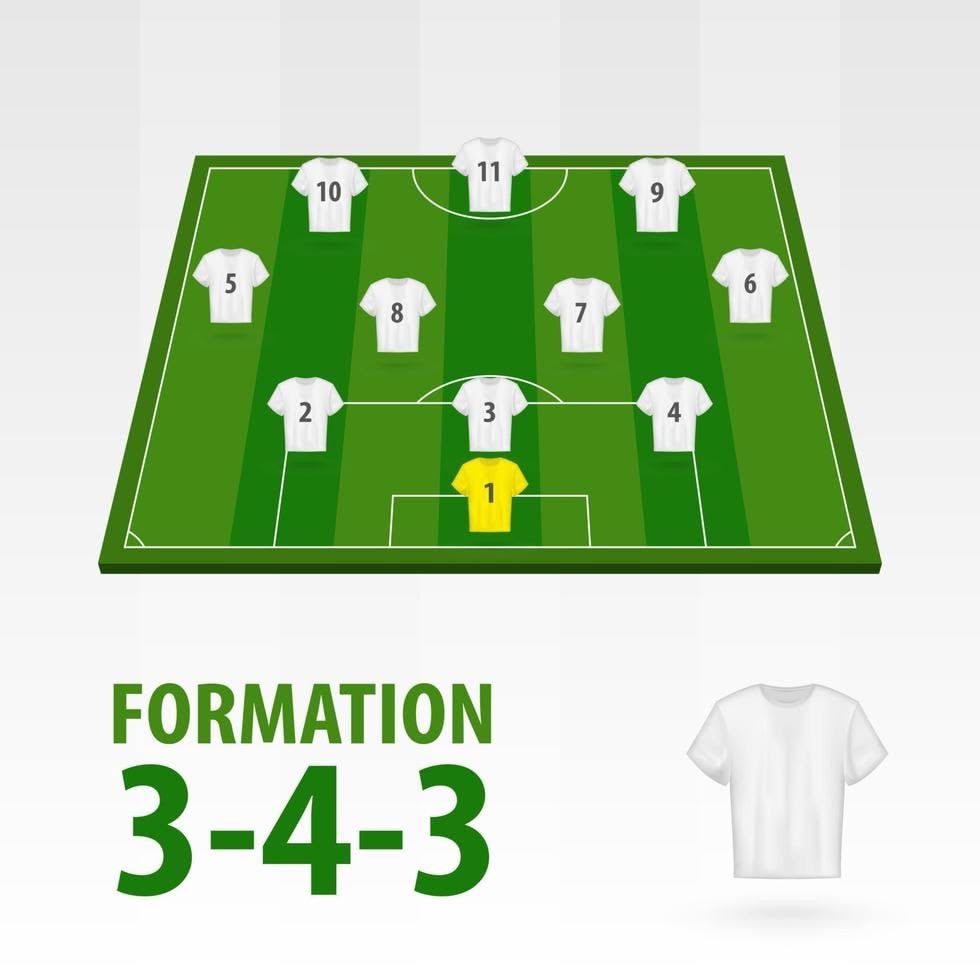
For years, the conversation around football formations has been dominated by the 4-2-3-1 and the 4-3-3. But a quieter revolution has been taking place on the touchlines of Europe’s elite, and the data is now catching up with what tacticians have suspected for a while: the 3-4-3 has become one of the most effective systems in the modern game. A recent comparative study of Europe’s top leagues found that while the 4-2-3-1 remains the most commonly deployed shape, it is the 3-4-3 that delivers the highest average points per match. So why are more managers buying in?
What the Research Actually Found
The headline comes from a 2026 study published in BMC Sports Science, Medicine and Rehabilitation, which analysed more than 2,100 matches and over 4,000 individual formation data points across six major European leagues, drawing on OPTA data verified against fbref. The researchers grouped formations into eight structural categories and tested their relationship with success using statistical methods including analysis of variance and chi-square tests.
Two findings stand out. First, the 4-2-3-1 was comfortably the most frequently used formation across the board — the default setting of modern football. Second, and more intriguingly, it was the 3-4-3 that returned the highest average points per match of any system studied. In other words, the most popular formation and the most effective one are not the same thing. The study also noted that the 3-4-3 was particularly prevalent in the Bundesliga and Serie A, while five-defender formations, by contrast, tended to yield lower average points and more limited success.
Crucially, the authors were careful not to crown the 3-4-3 a magic bullet. Their conclusion was more nuanced: a formation’s effectiveness is not determined by its structure alone, but by how well it aligns with league culture, the profiles of the players available, and the wider strategy of the manager deploying it. A shape is only as good as the squad and the ideas behind it.
Flexibility: The 3-4-3’s Superpower
The single biggest reason for the 3-4-3’s rise is its sheer adaptability. Few systems shape-shift as fluidly between attacking and defending phases. In possession, the wing-backs push high and wide to join the front three, transforming the shape into something resembling a front five that pins the opposition’s back line and stretches it to breaking point. The same eleven players, out of possession, can drop into a compact 5-2-3 or 5-4-1 block, with the wing-backs tucking in to form a back five that is notoriously difficult to break down.
This in-game elasticity is exactly what modern managers crave. The best sides no longer play one rigid shape for ninety minutes; they morph continuously depending on whether they have the ball. The 3-4-3 bakes that flexibility into its DNA. It can also be reconfigured centrally into a box midfield, generating numerical overloads in the middle of the pitch where so many matches are won and lost. One formation, many faces.
Why Managers Are Adopting It
It solves the build-up problem. A back three gives teams a natural numerical advantage against the common one- and two-striker presses. With three centre-backs spreading wide and a deep midfielder dropping in, sides can build out from the back with composure, baiting the press and playing through it rather than launching the ball long. In an era where playing out from the back is gospel, that structural head start is enormously valuable.
It weaponises the wing-back. The modern game has produced a generation of relentless, athletic wide players who can defend a flank and overlap to deliver in the final third. The 3-4-3 is built for them. By handing the entire width of the pitch to two specialist wing-backs, managers free their wide forwards to drift inside into dangerous half-spaces, creating overloads and unpredictability that a flat back four struggles to contain.
It offers defensive security without sacrificing attack. The three central defenders provide cover across the width of the box and insurance against quick counters — a safety net that allows the wing-backs and forwards to commit forward more aggressively. It is a system that lets a team be expansive and protected at once, which is the holy grail of tactical design.
It controls central areas. By generating midfield overloads and packing bodies into the centre, the 3-4-3 helps teams dominate the most contested zone on the pitch. Against opponents committed to two central midfielders, that numerical edge can be decisive in dictating tempo and territory.
A Pedigree of Success
The system is not new — its resurgence is a return to favour rather than an invention. Back-three structures have long carried a winning pedigree, with managers like Antonio Conte and Thomas Tuchel using variations of the three-at-the-back model to claim league titles and continental honours at the likes of Juventus, Chelsea, and Inter Milan. In the Premier League alone, clubs from Chelsea and Manchester City to Tottenham and Nottingham Forest have turned to the 3-4-3 at various points in recent seasons, drawn by its blend of solidity and attacking thrust.
Its concentration in the Bundesliga and Serie A is no accident either. German football’s emphasis on intensity and transition, and Italian football’s deep tactical tradition of defensive organisation, both lend themselves naturally to a system that prizes structure and shape-shifting in equal measure.
The Caveats
For all its strengths, the 3-4-3 is not a plug-and-play solution. Its effectiveness hinges on personnel. Without two genuinely two-way wing-backs capable of covering enormous distances for ninety minutes, the system creaks — the flanks become exposed, and the front five never properly materialises. The three centre-backs must be comfortable defending in wide channels and progressing the ball, profiles that are not always easy to assemble. And the physical demands on the wing-backs are punishing, raising real questions about sustainability across a long, congested season.
This is precisely why the research stops short of declaring the 3-4-3 universally superior. The numbers show it produces the best results on average, but those results are inseparable from the clubs deploying it — often well-coached, well-resourced sides with exactly the right players. Drop the same shape onto an ill-suited squad and the advantage evaporates.
The Verdict
The rise of the 3-4-3 tells us something important about where modern football is heading. The most successful managers are no longer wedded to a single static shape; they want systems that flex, that solve multiple problems at once, and that turn the players they have into the players they need. The 3-4-3 — expansive yet secure, fluid yet structured — fits that brief almost perfectly.
It may never overtake the 4-2-3-1 in raw popularity; the four-defender systems are simply easier to coach and to staff. But as the data makes clear, popularity and effectiveness are different things. For the managers willing to find the right wing-backs and drill the right movements, the 3-4-3 has become one of the smartest bets in European football. Expect to see a lot more of it.